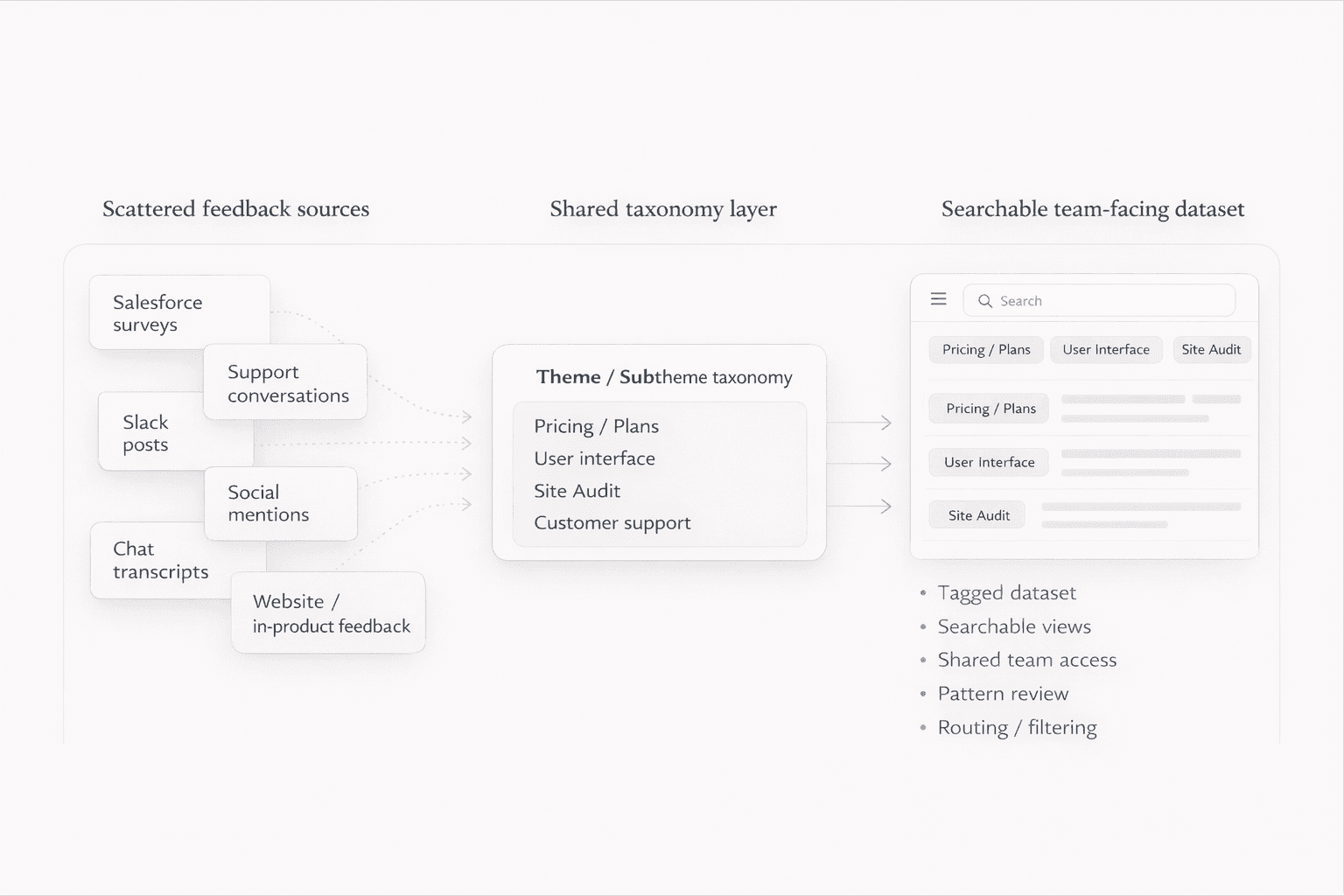
TL;DR
Problem: Customer feedback was spread across too many channels, tools, and team-specific workflows, making it difficult to compare patterns, attach business context, or route insights back to the right teams.
What I did: I supported the program manager on an early Voice of the Customer effort by helping structure high-volume feedback into a more reusable system. This included feedback mapping, taxonomy support, spreadsheet-based organization, and early summaries that made multi-channel signal easier to search, compare, and review.
Outcome: This work helped move feedback from scattered one-off mentions toward a more structured dataset teams could use more consistently, laying the groundwork for shared visibility, filtering, and self-serve pattern review.
Context
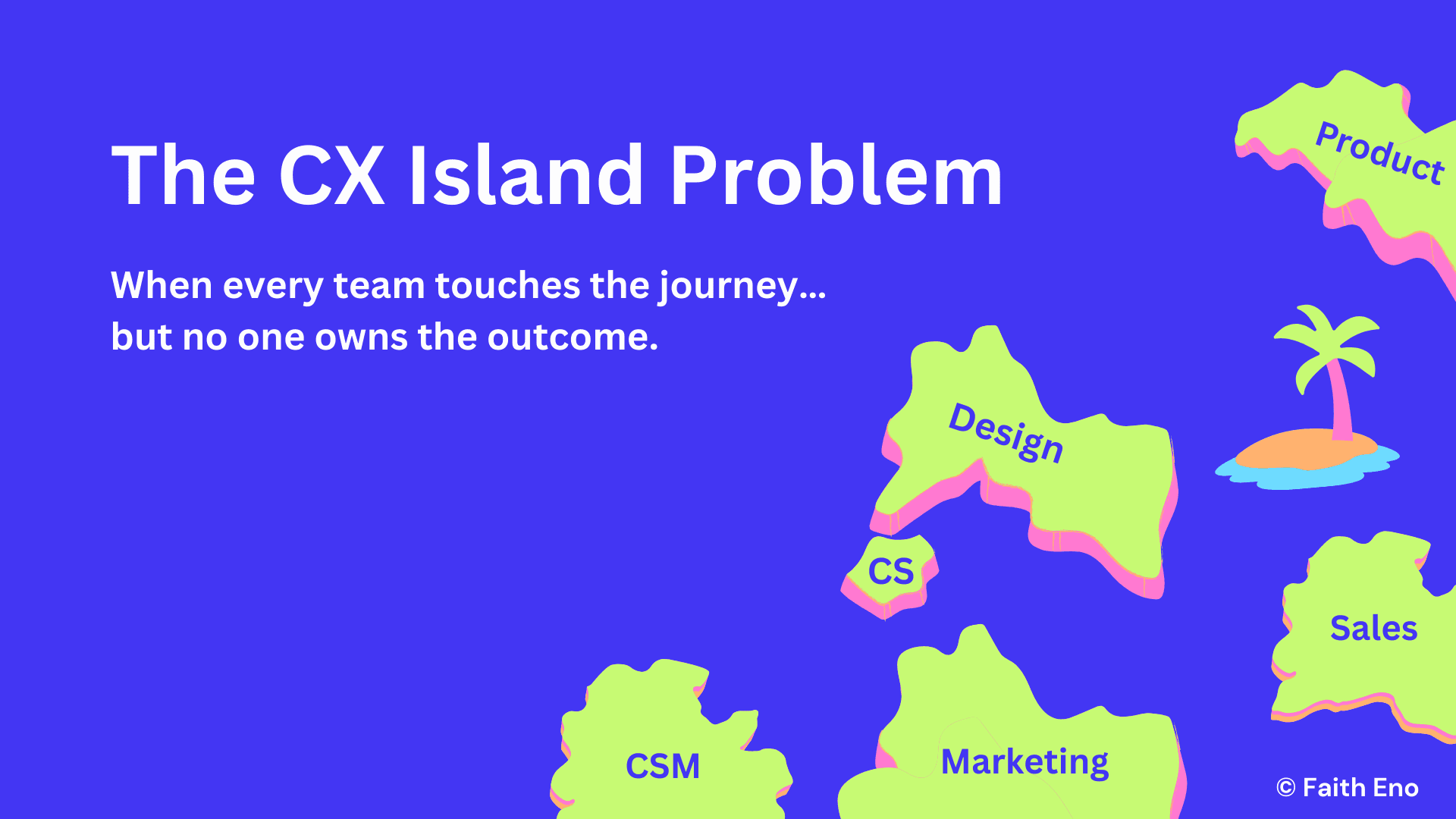
Customer feedback at Semrush was coming from many places at once: surveys, support conversations, Slack, chat, social media, website forms, and in-product feedback. Different teams stored and handled that signal differently, which made it hard to consolidate patterns or work from a shared view.
In one month, feedback volumes included 1,439 phone calls, 2,876 chats, 638 surveys, and roughly 800 social mentions per day. At that scale, even useful customer signal became difficult to track or compare when it lived across separate systems and workflows.
The core issue
The challenge was not collecting feedback. It was making that feedback usable.
Teams were often working from isolated comments, channel-specific views, or one-off Slack mentions instead of a shared structure. That made it harder to identify repeat themes, reduce duplication, or understand which patterns were most important.
My role
I supported the program manager on an early-stage Voice of the Customer initiative focused on feedback mapping, taxonomy support, and dataset organization.
I did not lead the program or build the tooling itself. My role was to help make unstructured feedback more usable by supporting consistent tagging, shared data organization, and a clearer understanding of how customer signal moved across teams and systems.
What I did
Mapped feedback sources and workflows
I helped document where feedback came from, where it lived, and how different teams handled it. This made fragmentation more visible and clarified where a more consistent structure was needed.Supported a reusable taxonomy for open-text feedback
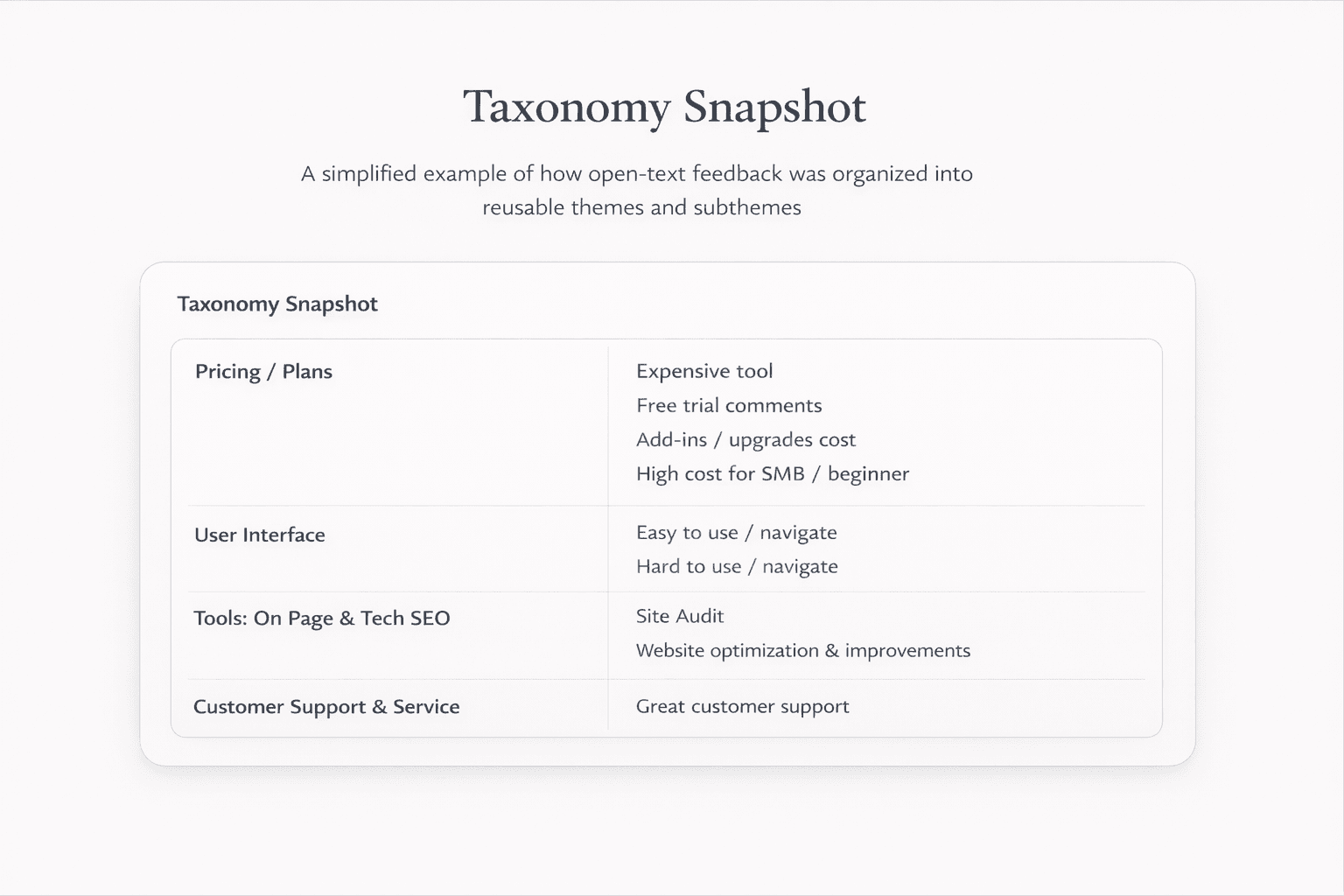
I helped apply a Theme/Subtheme structure to unstructured customer feedback so recurring issues could be grouped more consistently across sources. The value was not just tagging comments once, but helping create categories stable enough to support repeated use.Helped organize shared datasets in spreadsheets
I supported the cleanup and structure of shared feedback datasets so teams could work from a more comparable set of inputs instead of isolated channel-by-channel views.Contributed to early rollups and pattern summaries
I supported spreadsheet-based summaries to make repeating themes easier to review and discuss. This work was less about advanced analytics and more about making high-volume qualitative signal easier for teams to use.
Why it mattered
Taxonomy was not just an analysis here. It was infrastructure.
By helping apply a consistent structure to feedback across multiple channels, I contributed to a system that made open-text feedback more searchable, comparable, and reusable across teams. Because the categories were stable, the dataset could support filtering, shared views, and easier pattern review over time rather than acting as a one-off analysis.
This reduced some of the friction of working from scattered anecdotes and made it easier for teams to self-serve recurring themes without rereading raw comments every time.
Outcome
Helped move multi-channel feedback toward a more structured and reusable dataset
Supported shared visibility across teams working from different tools and workflows
Made recurring patterns easier to compare, filter, and discuss
Strengthened the operational foundation for using customer feedback more consistently
Selected artifacts
High-level map of feedback channels, storage locations, and volume across the VoC ecosystem.
Example Theme/Subtheme structure used to make open-text feedback more comparable across sources.
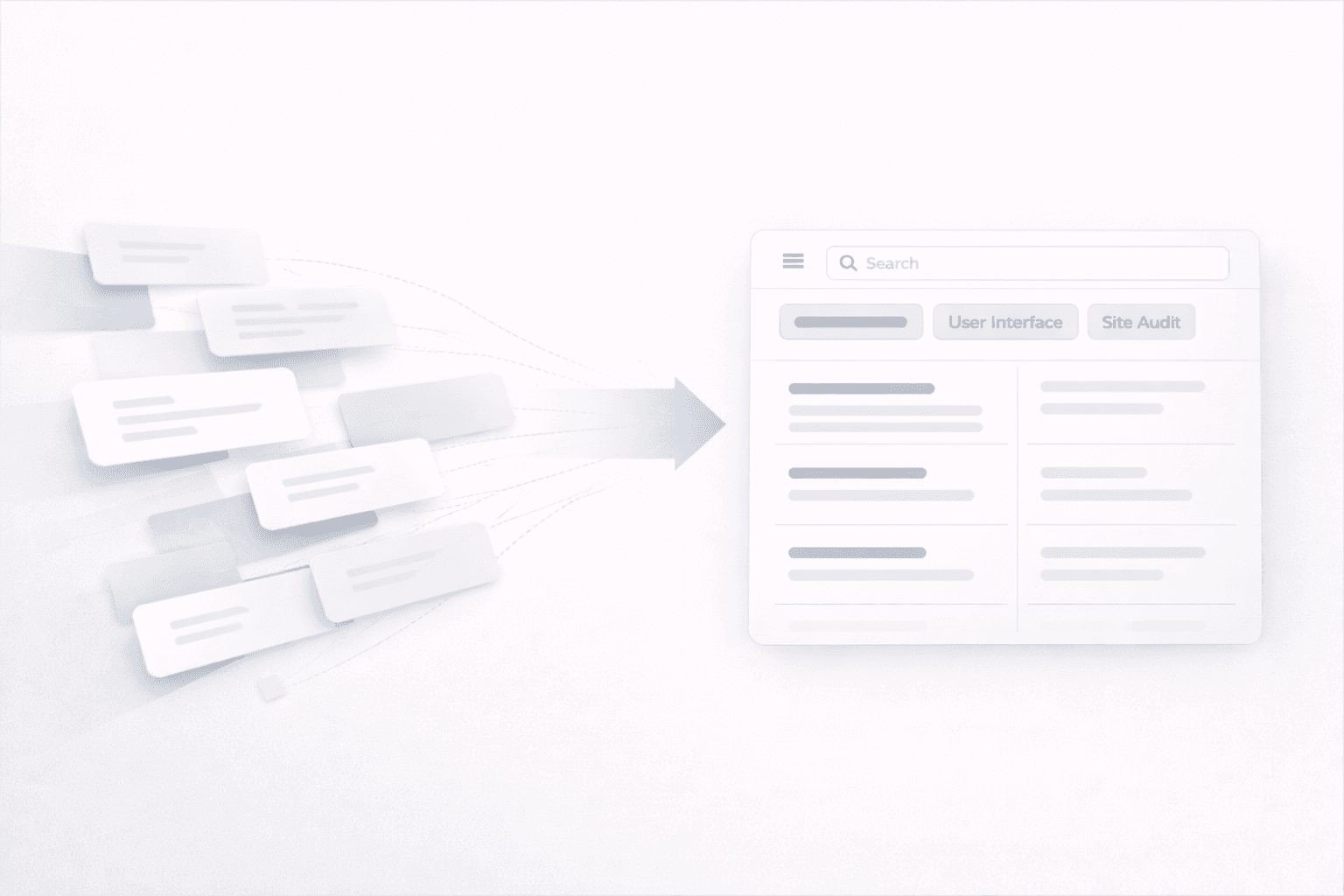
Simplified workflow showing how feedback moved from channel inputs into shared spreadsheet and Airtable views.