
TL;DR
The Problem:
Ahimsa was preparing to expand into baby registries and needed to understand whether their premium stainless-steel tableware could be positioned like "grow-with-me" baby products (e.g., strollers, car seats) to drive earlier adoption and overcome price barriers. Internally, this idea was plausible but risked being built on assumptions about how parents actually think about feeding stages and registries.
What I Did:
I led a mixed-method market research study combining parent interviews, social listening, and keyword analysis to uncover real parent mental models around feeding, registries, tableware materials, and gifting behavior. Rather than validating a single concept, I reframed the research to surface how parents actually prioritize products while still answering the original business question.
Outcomes:
Clarified why tableware is not naturally perceived as a "grow-with-me" category
Identified realistic entry points for earlier registry adoption (e.g., cups and spoons as gateway products)
Provided Ahimsa with its first-ever direct research on its target audience, establishing a foundation for future product, messaging, and registry strategy decisions
The Core Insight: Misaligned Mental Models, Not Product Value
Parents don't organize feeding products by growth stages; they organize them by urgency, effort, and social proof. Early attention is consumed by feeding success (bottles, milk, colic), while tableware is deferred unless it's framed as durable, gift-worthy, and socially validated. The opportunity wasn't forcing a new category; it was meeting parents where their decision-making already lives.
“I was more concerned with bottles and feeding right after birth. Tableware felt like something I’d deal with later.”
The Business Question Beneath the Assumption
Why the brand wanted to test "grow-with-me" and what was really at stake
Ahimsa was preparing for a pivotal expansion moment.
The brand had built strong traction selling premium stainless-steel tableware primarily to families with toddlers. Their products were durable, well-designed, and intentionally positioned as higher-quality alternatives to plastic and silicone. But most of their sales happened later in the feeding journey, after parents had already formed habits around tableware.
As Ahimsa prepared to launch in Buy Buy Baby, a retailer where baby registries play a central role in discovery, a strategic question surfaced:
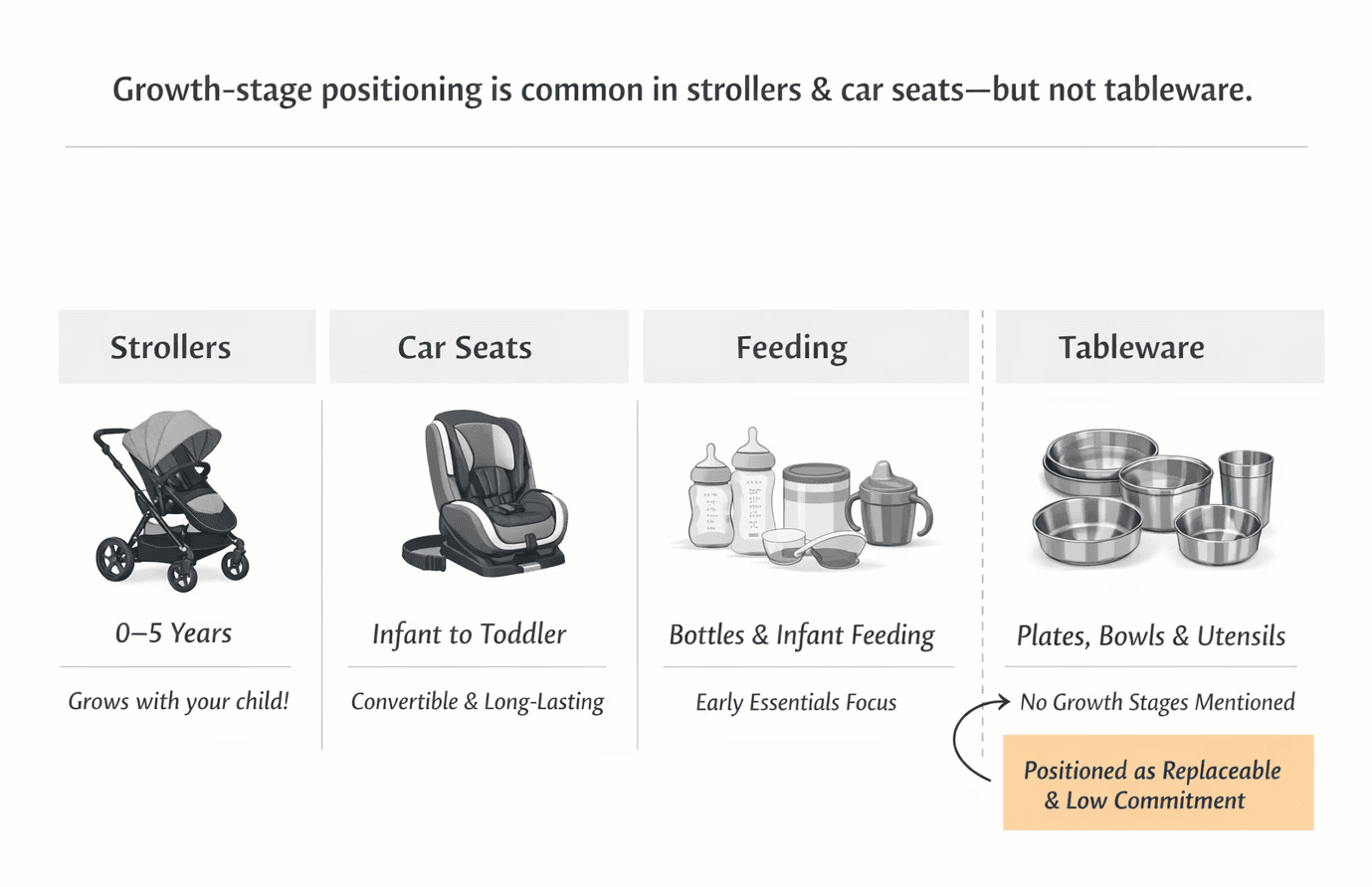
Could tableware be positioned like other long-term registry investments, such as strollers or car seats, to drive earlier awareness and adoption?
Behind that question were several real business pressures:
Registry economics: Expensive items are more likely to be purchased as gifts than self-purchased.
Timing mismatch: Parents most often buy Ahimsa products at toddler age, but registries are created much earlier.
Category precedent: "Grow-with-me" systems (strollers, cribs, high chairs) succeed because they promise longevity across stages.
Risk: If tableware didn't fit this mental model, forcing the comparison could confuse customers or cause the real opportunity to be missed entirely.
This wasn't a question about wording or messaging alone.
It was a category-level bet:
Do parents mentally group tableware with long-term investments?
If not, why does it not belong, and where does it actually belong in their decision hierarchy?
And how could Ahimsa realistically enter the conversation about the registry without relying on a false analogy?
Complicating matters, this was the brand's first formal research effort into their target audience. The study needed to do more than validate a single idea; it needed to establish a reliable foundation for future decisions.
Inheriting the Question Without Inheriting the Bias
How I course-corrected the study without derailing scope, trust, or timeline
I stepped into this project after the initial research direction had already been defined.
The original research plan, developed collaboratively by the client and a lead researcher, focused on testing whether Ahimsa's tableware could be framed as a "grow-with-me" system comparable to strollers or car seats. The scope had been discussed, aligned on, and was close to execution.
At the same time, the framing leaned heavily toward confirmation:
It assumed parents had already considered tableware in a staged, long-term way.
It risked narrowing the study to proving whether the analogy worked, rather than understanding how parents actually reasoned about feeding products.
Rather than restarting or rejecting the plan outright, I took a second-pass clarification approach.
Re-engaging intent, not undoing prior work
I met with stakeholders weekly and worked asynchronously in shared documents to:
Clarify why the "grow-with-me" idea mattered to the business
Separate the strategic goal (earlier awareness, registry inclusion, price barrier mitigation) from the assumed mechanism
Expand the research lens just enough to capture real parent mental models without blowing up scope or timelines
This meant navigating two layers of alignment:
Respecting work already done by the lead researcher
Gently reframing assumptions with the client without dismissing their instincts
Safeguarding research integrity inside real constraints
Instead of positioning this as "the question is wrong," I reframed it as:
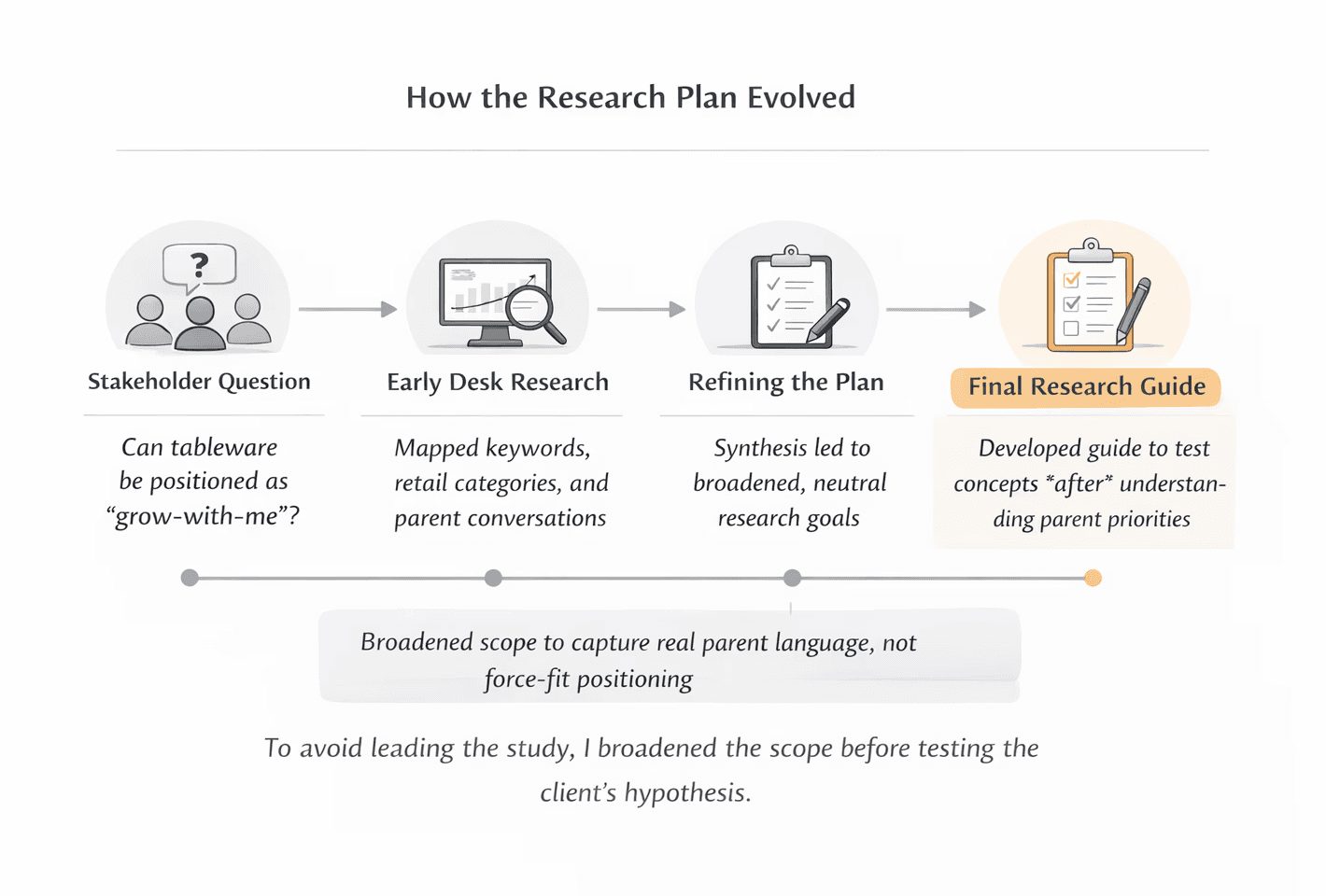
To know whether tableware can behave like a grow-with-me system, we first need to understand how parents categorize feeding products at all.
That shift allowed the study to:
Still test the original idea
But do so indirectly and rigorously, by grounding it in observed behavior rather than hypotheticals
I documented these shifts transparently in the research plan, shared updates asynchronously, and validated changes during live check-ins. Stakeholder feedback was immediate and affirming:
“These shifts are excellent. Thank you for thinking and going deeper.”
“Agree!!!”
The result was a repositioned study:
Still aligned to the business question
No longer constrained by a single assumed outcome
Designed to surface actionable clarity, even if the original hypothesis didn't hold
Looking Before Asking
Using market signals to shape the research before speaking to parents
Before writing a single interview question, I needed to ground the study in how parents were already behaving, not how we hoped they might behave.
Because this project sat at the intersection of market research and UX research, I started by mapping the broader landscape parents navigate when making feeding-related decisions. The goal wasn't to replace interviews with desk research, but to ensure the primary research was informed by real-world signals rather than internal assumptions.
This phase served three purposes:
Pressure-test the "grow-with-me" idea before introducing it to participants
Identify which tableware categories actually matter to parents at different stages
Shape an interview guide that reflected real language, priorities, and trade-offs
1. Social listening: how parents talk when brands aren't in the room
I reviewed discussions across "crunchy mom" and general parenting communities, focusing on posts where parents were actively debating or recommending tableware.
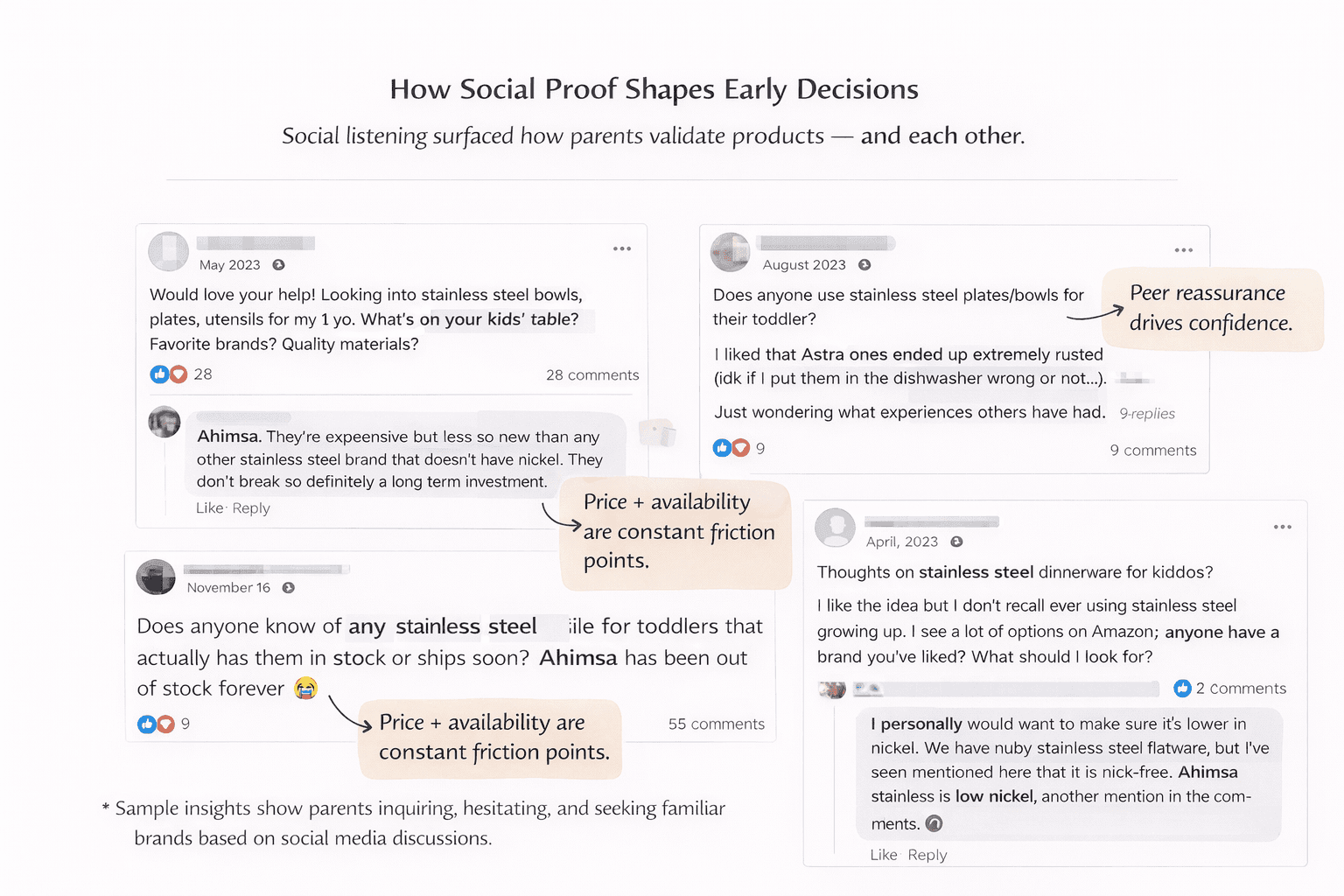
This surfaced several patterns that immediately challenged a purely stage-based framing:
Durability and longevity dominated the conversation, often framed as "will this survive daily abuse?"
Stainless steel was associated with heirloom quality or cultural familiarity, but also raised questions around:
Scratching
Noise when dropped
Painted vs. heat-treated finishes
Trust was built through peer validation, not brand claims, especially in Facebook groups and registry communities
Many premium items were discussed as gifts or group purchases, not everyday self-purchases
These conversations revealed something critical:
Parents weren't organizing their thinking around abstract growth stages.
They were organizing it around pain avoidance, reliability, and social proof.
That insight shaped how I approached both recruitment and questioning.
2. Keyword research as behavioral market evidence (not SEO)
To complement the qualitative signals, I analyzed search behavior using keyword research as a proxy for demand and decision timing — not as a marketing exercise.
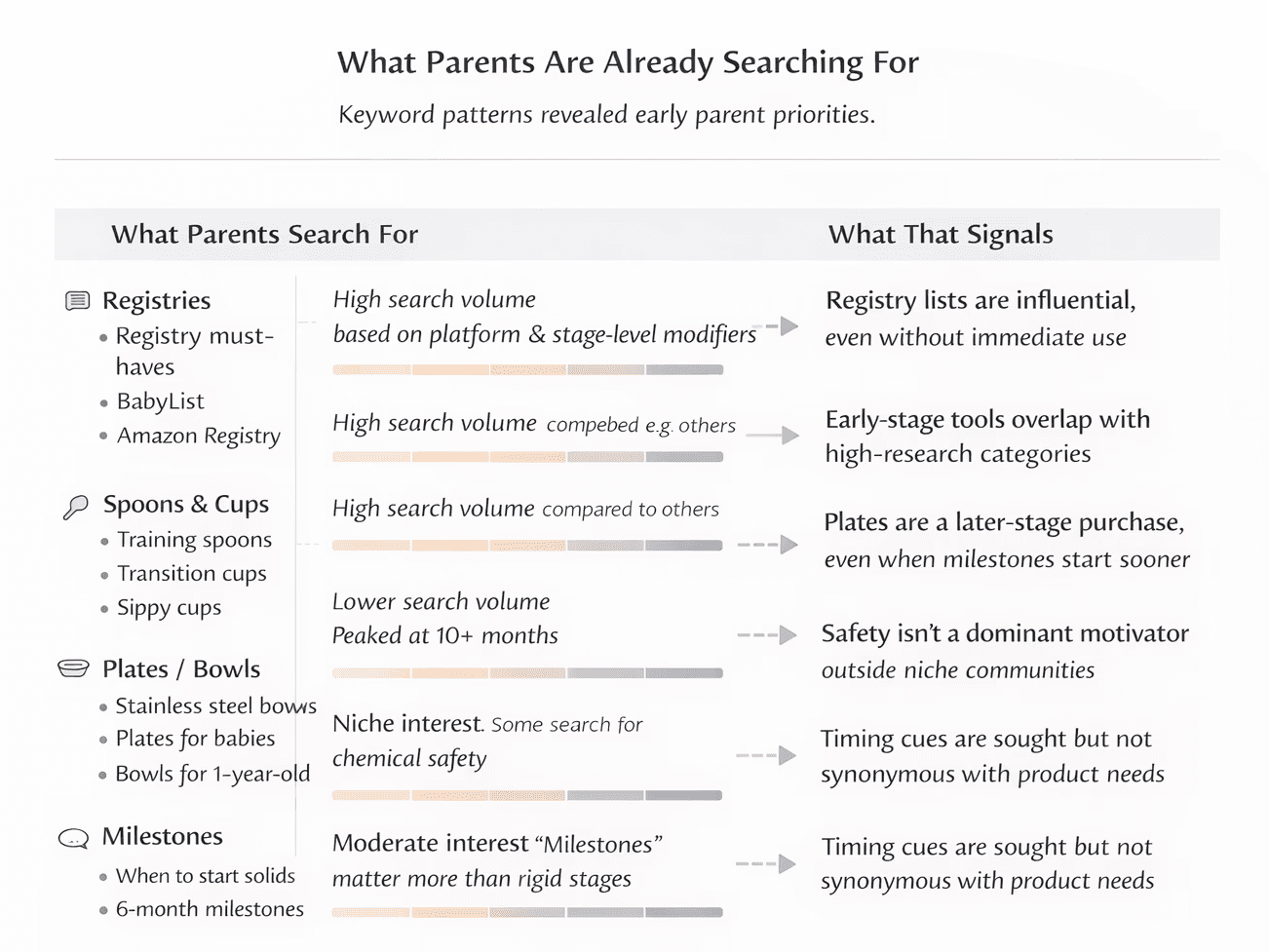
Key patterns emerged:
Registry behavior is list-driven
"Baby registry must-haves" and "baby registry checklist" (~8,100 searches/month) signal that parents rely heavily on curated guidance.
Early-stage tableware interest concentrates in spoons and cups
Baby spoons (2,900/month)
Cups (7,230/month total)
"Stainless steel sippy cup" (880/month) stood out as the strongest stainless-specific signal.
Plates and bowls appear later and are feature-driven
Searches skew toward modifiers like "suction" rather than materials or longevity
Material safety is niche but high-intent
"Non-toxic" and "plastic-free" queries were low volume but strongly values-driven
Milestone questions trigger purchasing.
Queries like "when can baby drink from a straw" suggest buying happens in response to developmental prompts, not abstract planning.
Taken together, the data suggested:
If tableware enters the registry conversation early, it's more likely through gateway items (spoons, cups)
Stainless steel is viable, but only when paired with clear functional or longevity benefits
Stage-based marketing alone wouldn't match how parents search, but milestone education could
3. Retail category analysis: how stores frame the decision for parents
I also reviewed how major baby retailers organize feeding products across:
General department stores
Baby-focused retailers
Registry-specific experiences
Across these environments, tableware was:
Rarely framed as a long-term system
Often grouped by immediate function (bottles, feeding tools, utensils)
Positioned as low-risk, easily replaceable items
This reinforced a key tension:
The business wanted tableware to behave like a long-term investment —
but the market framed it as an incremental, low-commitment purchase.
How this shaped the primary research
By the time I drafted the interview guide, the strategy was clear:
Do not lead with "grow-with-me" language
Start with parents' own categories, timelines, and priorities
Observe whether and when long-term thinking emerges naturally
Introduce the concept only after establishing mental models — and watch how parents react
This approach allowed the research to:
Test the client's hypothesis without anchoring participants to it
Surface opportunities the original framing might have missed
Generate insights that were both strategically honest and commercially useful
Testing the Idea Without Teaching It
Designing interviews that surfaced real mental models, not polite agreement
With the landscape mapped and assumptions pressure-tested, the next challenge was methodological:
How do you evaluate a stakeholder's idea without planting it in participants' minds?
The client wanted to understand whether tableware could be positioned as "grow-with-me" systems (e.g., strollers or car seats) to drive earlier inclusion in registries. But introducing that concept too early risked turning the interviews into a validation exercise rather than discovery.
My approach was to earn the right to ask about growth, longevity, and timing by first understanding how parents naturally think about feeding, registries, and future planning.
1. Recruitment: choosing parents who were actively deciding
Participants were selected to reflect real decision-makers, not hypothetical planners:
Expectant mothers and parents of infants under one year
Mix of first-time and second-time parents
Actively building or recently completing baby registries
Shopping across both high-end baby retailers and mainstream stores
Importantly:
No participants were existing Ahimsa customers
Awareness of the brand or stainless steel tableware was limited or indirect
This ensured feedback reflected market reality, not brand affinity
This recruitment strategy allowed the study to capture:
Early-stage priorities
Registry trade-offs
How future-oriented thinking actually shows up or doesn't show up during baby registry creation
2. Interview structure: letting parents lead the frame
The interviews were intentionally structured in layers, moving from concrete behavior to abstract reflection.
Layer 1: What's happening right now
What items were recently added to the registry and why
Immediate anxieties (feeding, sleep, health)
Sources of guidance (family, blogs, registry platforms)
Layer 2: Looking ahead without labels
Which future stages parents were thinking about
What they felt pressure to "prepare for"
How they decided which future items were worth early investment
Layer 3: Feeding & tableware in context
When solids entered the picture
How utensils fit (or didn't) into early feeding plans
What made tableware feel optional vs. essential
Only after these mental models were clearly established did I introduce:
The idea of long-term or adaptable products
Comparisons to items like strollers or convertible cribs
Reactions to longevity-focused framing
This sequencing made it possible to observe whether the "grow-with-me" idea resonated organically, or only after explanation.
3. Bias management: protecting the integrity of the study
Because the hypothesis was known internally, I was deliberate about avoiding confirmation bias at every step.
That meant:
Neutral language in the discussion guide
Avoiding leading examples until participants introduced comparable ideas themselves
Treating skepticism as signal, not resistance
Actively documenting disconfirming evidence during synthesis
When parents reacted to the "grow-with-me" concept, the dominant response was not confusion; it was clarity:
“That makes sense for some products… just not these.”
Parents consistently differentiated between:
Products that must evolve (strollers, beds, car seats)
Products that must endure (tableware)
This distinction became a cornerstone insight.
4. What parents actually revealed
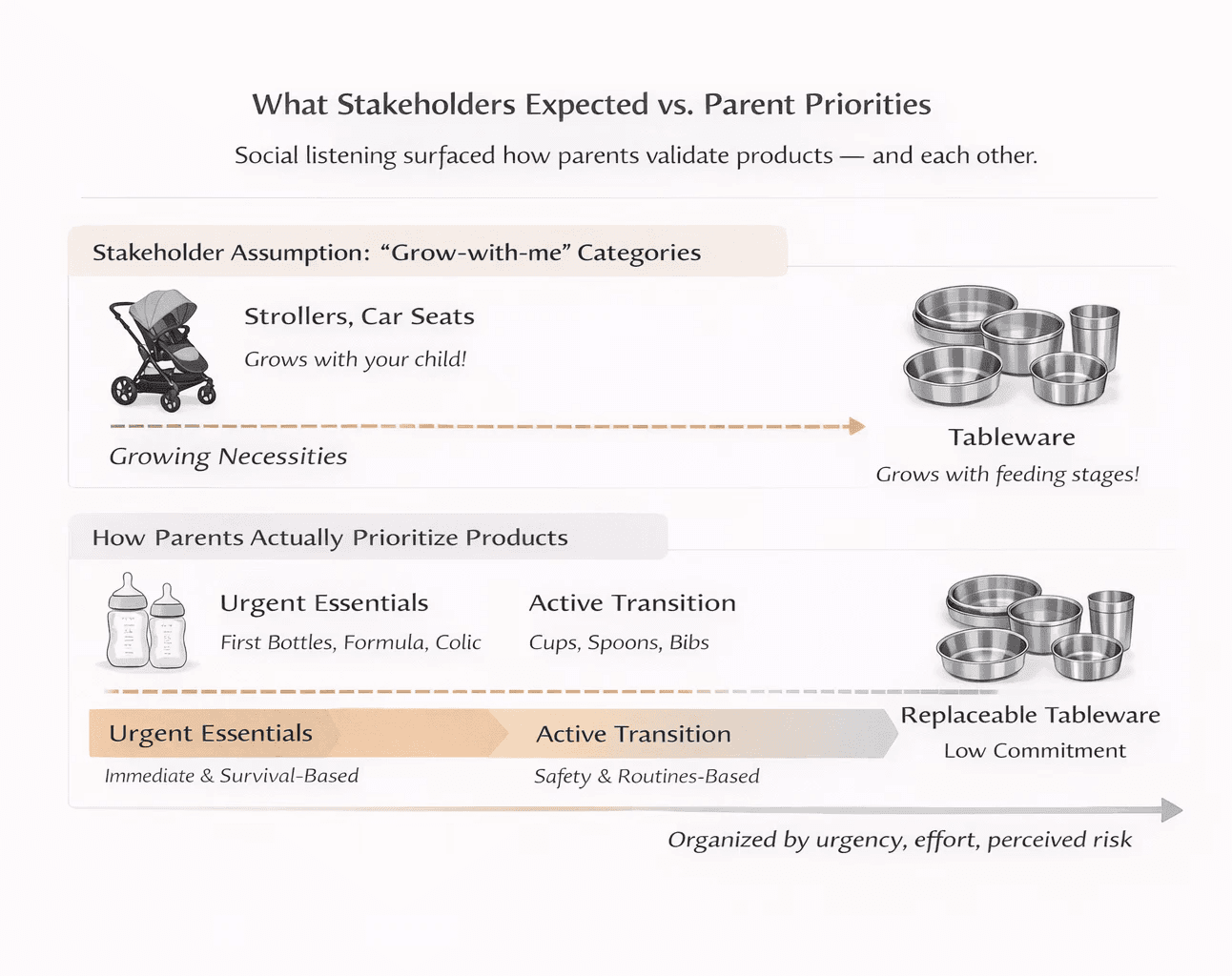
Several themes emerged quickly and repeatedly:
Feeding basics dominate early attention
Bottles, breastfeeding logistics, and formula concerns overshadowed everything else during registry creation.Starting solids ≠ using tableware
Parents expected months to pass before utensils mattered, even if solids began earlier.Tableware is seen as low-risk and replaceable.
Cheap, accessible, and easy to buy later, unlike large registry investments.Longevity is valued, but framed differently
Parents cared about durability and reuse, not staged evolution.Social proof drives confidence
Moms trusted other moms' lists, groups, and reviews far more than brand messaging.
These insights didn't reject the client's goal; they reframed the path to it.
When the Data Pushes Back
What parents revealed about "grow-with-me," feeding stages, and real buying behavior
By the time interviews were underway, a clear pattern began to emerge not through dramatic disagreement, but through consistent, calm reframing by parents themselves.
Parents didn't reject the idea of long-term thinking.
They rejected the idea that tableware belongs in the same mental category as strollers or car seats.
That distinction shaped everything that followed.
1. Feeding urgency reshapes registry priorities
Across interviews, one theme dominated early registry decisions:
Feeding anxiety comes before feeding tools.
Parents, especially first-time moms, were consumed with:
Breastfeeding success
Bottle compatibility
Colic prevention
Formula shortages
Milk storage and cleaning logistics
Tableware rarely entered the conversation at this stage, even for parents who planned to introduce solids early.
“I was way more focused on bottles and breastfeeding. Bowls you can get anywhere.” — P3
“Utensils weren’t driving my decisions. I cared about bottles and pacifiers because of colic.” — P1
Insight:
Registry decisions are driven by perceived risk.
Tableware feels low-risk, while feeding systems feel high-stakes.
2. "Grow-with-me" means transition not endurance
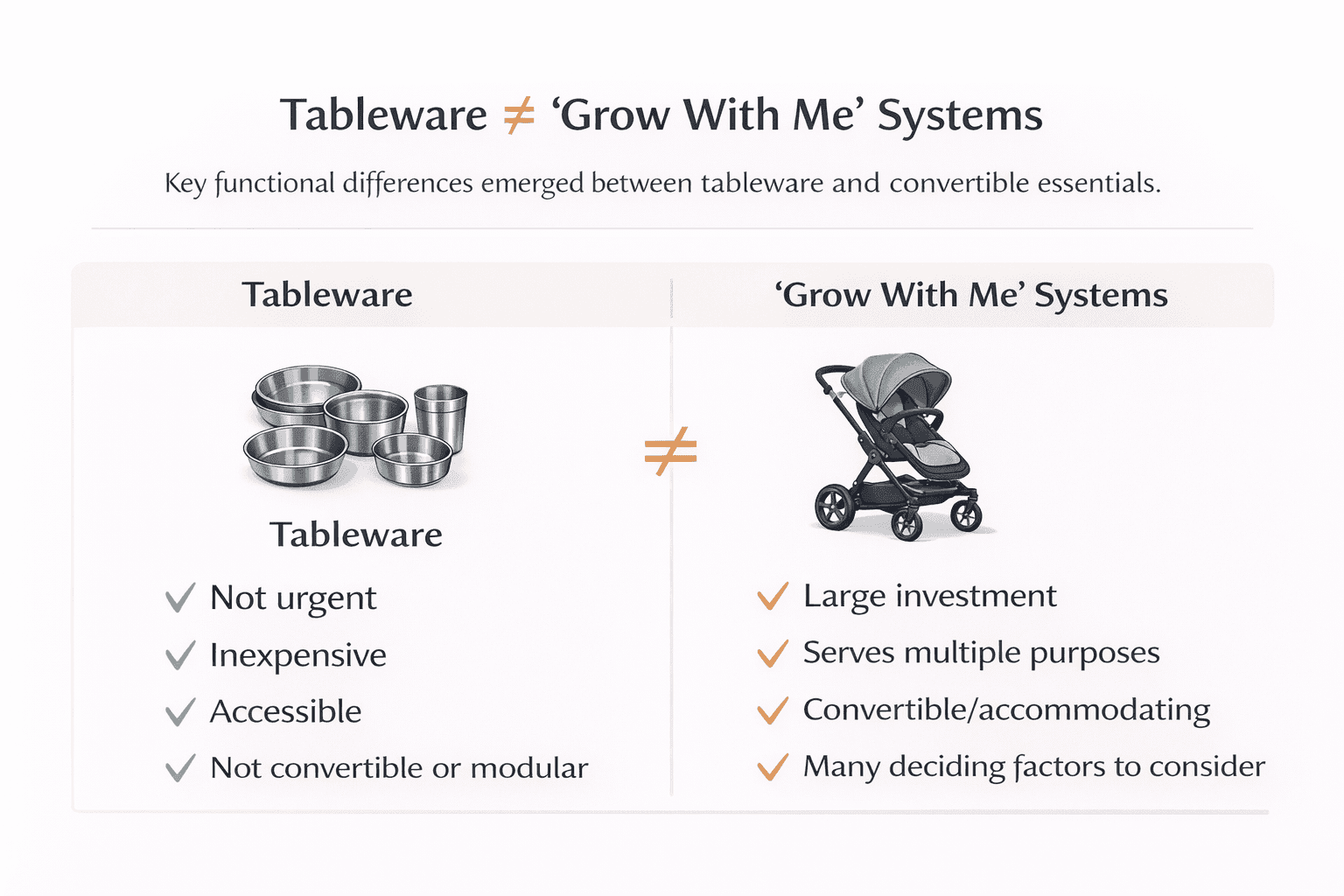
When parents described products, they did consider "grow-with-me," they used remarkably consistent language:
Convertible
Modular
Adaptable
Replace-many-with-one
Worth the upfront cost
These were almost always:
Strollers
Cribs
Car seats
High chairs
“I don’t want to buy the same thing over and over. A bed has to grow with them.” — P7
But when tableware entered the conversation, the framing shifted.
Parents still valued longevity but not staged growth.
Tableware was expected to:
Last
Be durable
Be replaceable if needed
Not require advance planning
“That makes sense for some products… just not these.”
Core insight:
Parents don't expect tableware to evolve.
They expect it to endure.
3. Starting solids ≠ using utensils
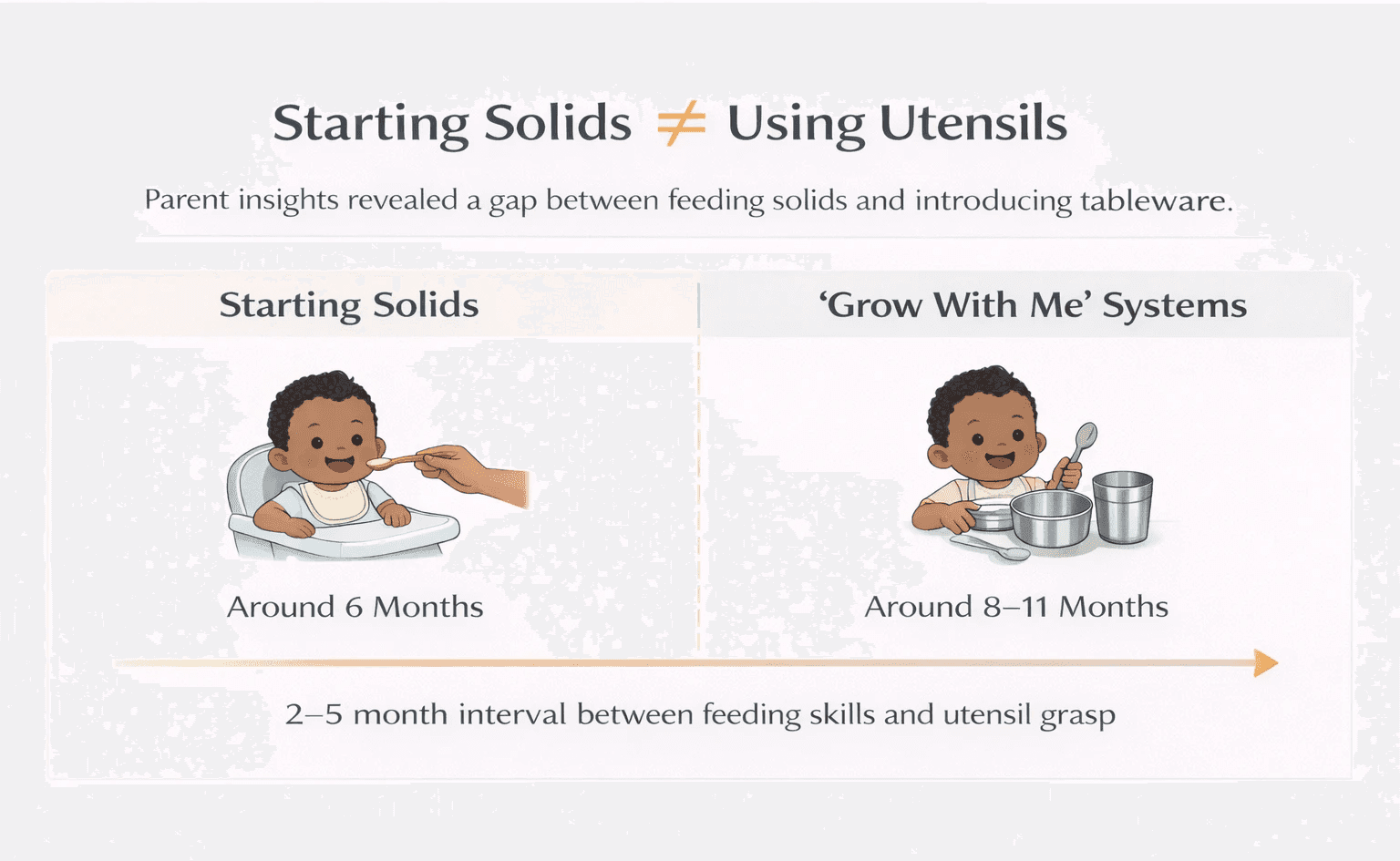
One of the most important disconfirming insights was timing.
While parents often planned to introduce solids between 4–9 months:
They did not expect babies to use utensils at that point
Many expected months to pass before tableware mattered at all
“Starting solids doesn’t mean they’re eating by themselves.” — P3
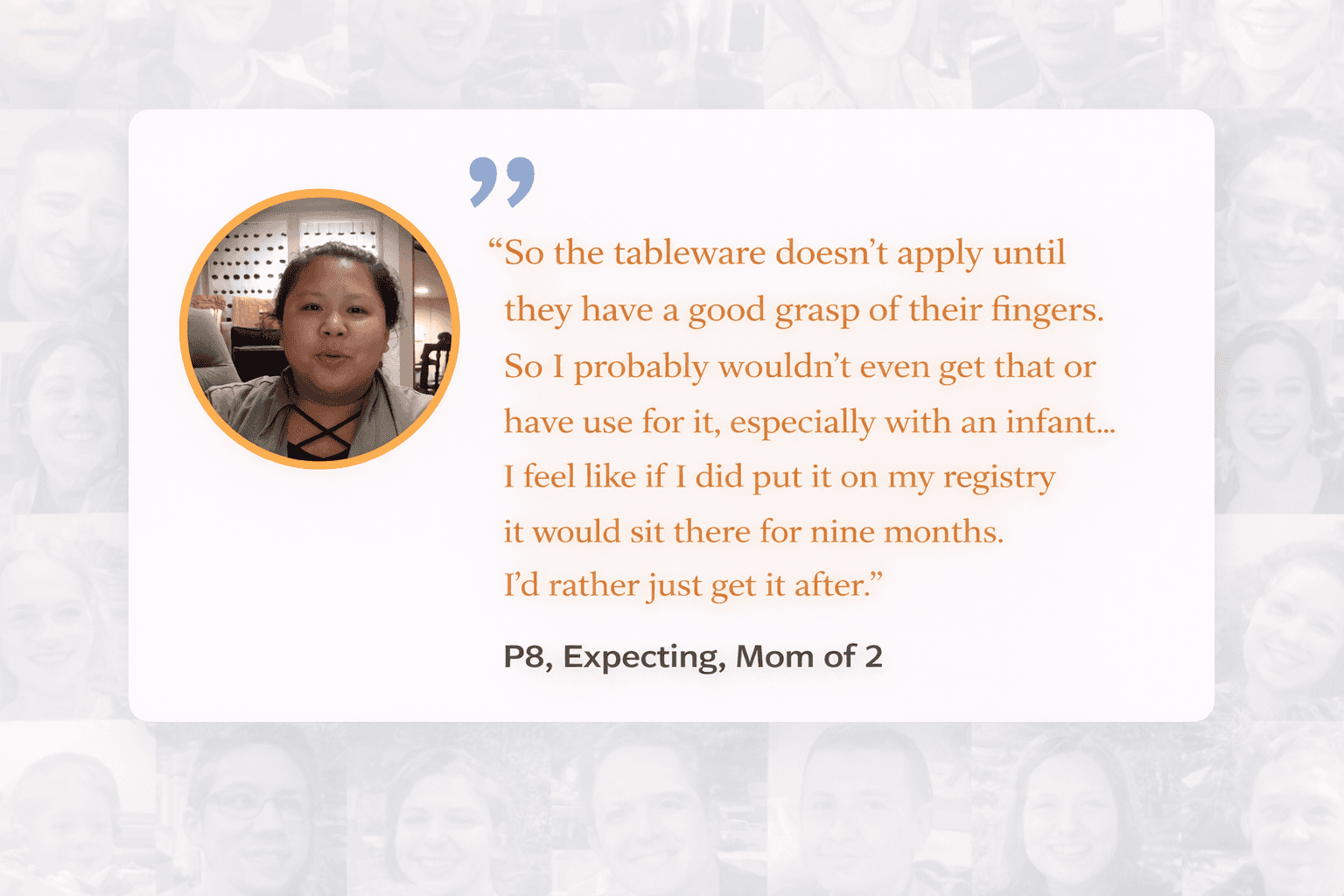
“If I put it on my registry, it would just sit there for nine months.” — P8
Implication:
Tableware feels like a later-stage purchase even when feeding milestones begin earlier.
This directly challenges the idea that registry inclusion equals immediate relevance.
4. Price perception + accessibility reduce urgency
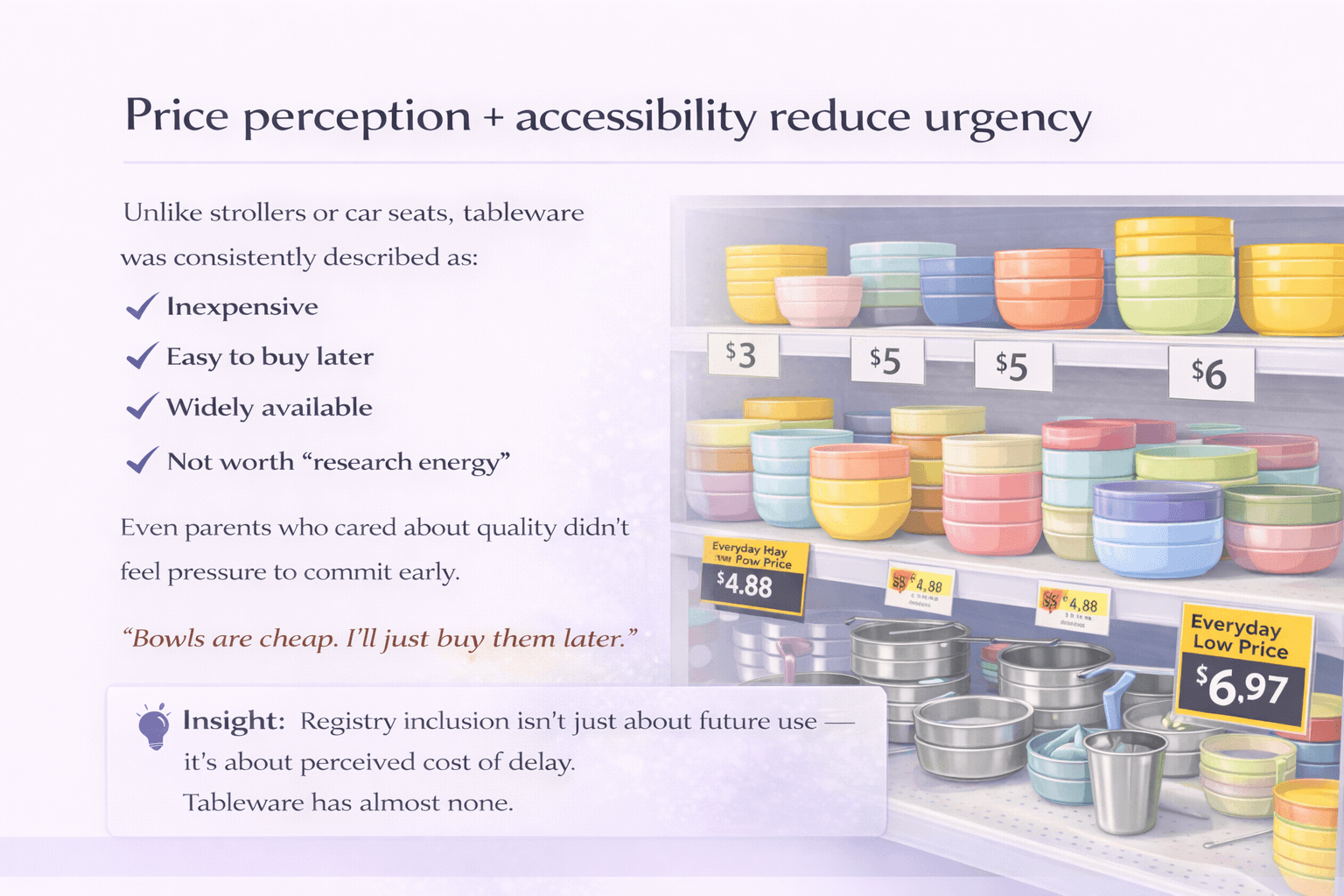
Unlike strollers or car seats, tableware was consistently described as:
Inexpensive
Easy to buy later
Widely available
Not worth "research energy"
Even parents who cared about quality didn't feel pressure to commit early.
“Bowls are cheap. I’ll just buy them later.”
Insight:
Registry inclusion isn't just about future use; it's about perceived cost of delay.
Tableware has almost none.
5. Chemical safety is not a mainstream driver
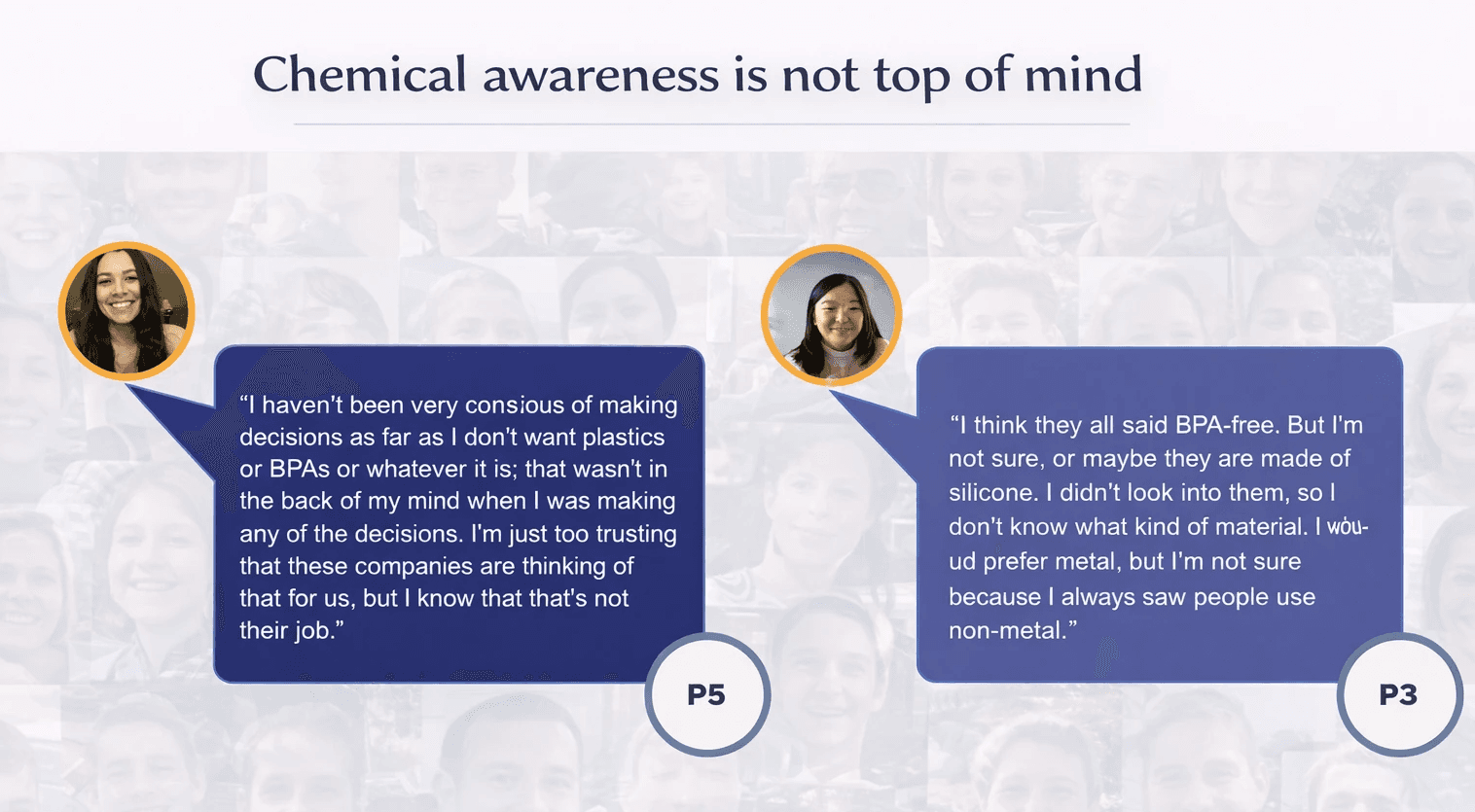
Outside of environmentally conscious or "crunchy" parents:
Most assumed products sold in the U.S. were "safe enough."
Material awareness was shallow
BPA-free was often the only remembered signal
“I trusted that baby products were already regulated.” — P2
This aligned with:
Keyword research shows low search volume for "non-toxic" modifiers
Social listening indicates safety concerns are niche, not universal
Implication:
Safety alone won't drive tableware into early consideration for the registry, especially at premium prices.
6. What does move confidence: social proof
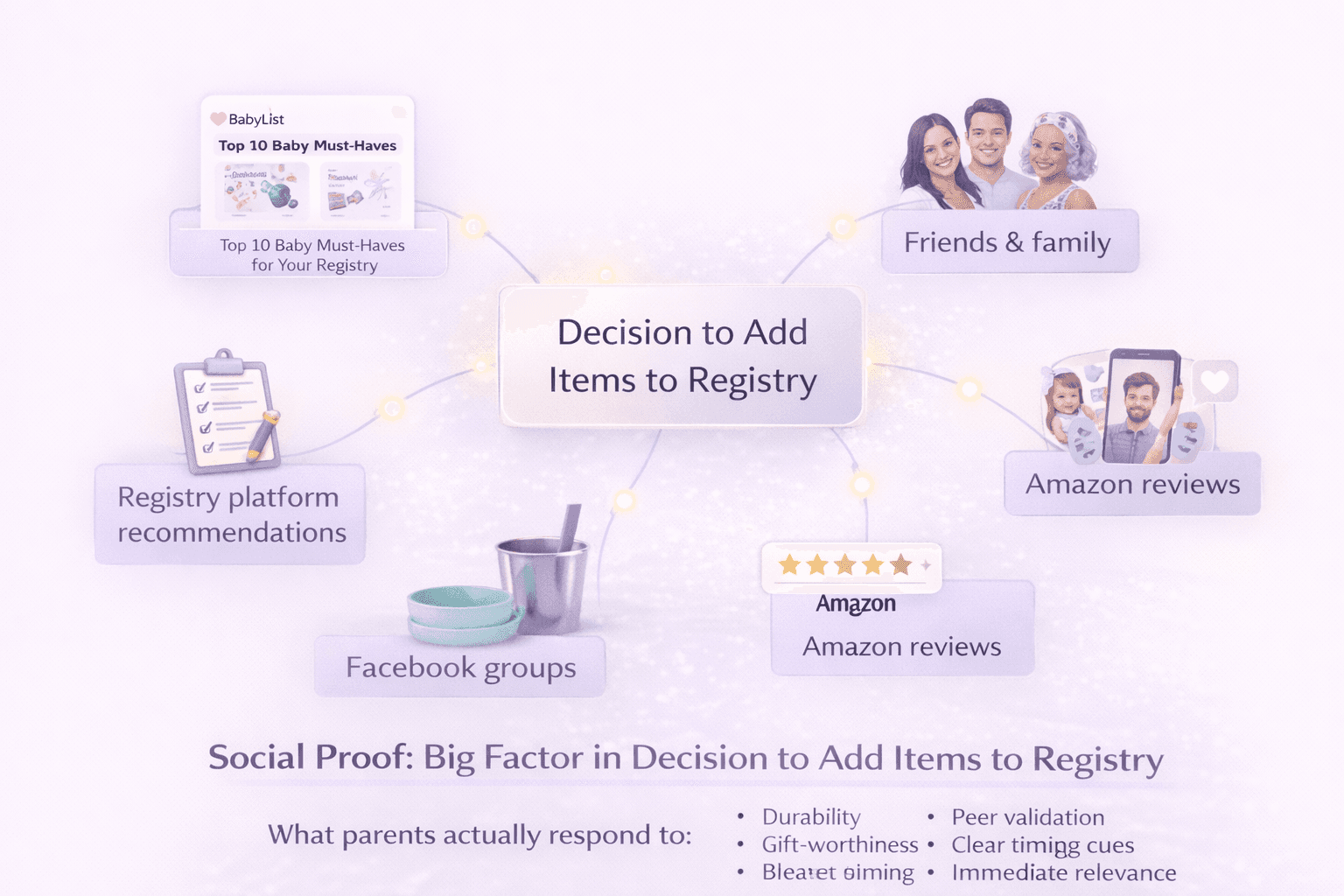
If anything pushed parents toward adding items early, it wasn't brand messaging — it was people.
Parents consistently cited:
BabyList and What to Expect "must-have" lists
Registry platform recommendations
Facebook groups
Friends, family, and influencers
Amazon reviews
“I added things my sister told me I needed not what brands told me.” — P3
Insight:
Registry behavior is socially mediated.
Trust travels through lived experience, not positioning language.
What this meant for the original idea
Parents don't map tableware to growth stages, but they do respond to:
Durability
Gift-worthiness
Peer validation
Clear timing cues
Entry-point products that feel immediately relevant
This reframing unlocked a more realistic path forward.
The Gift of Clarity
What the research ultimately delivered
This project did not end with a feature roadmap or a single tactical decision.
It ended with something more valuable: clarity.
For Ahimsa, this was the first time they had spoken directly with parents about how feeding products fit into real life, not just how they hoped those products might be perceived. The research surfaced a clear picture of how parents actually think, decide, and prioritize across the early years of feeding.
What became clear
Parents don't organize tableware by growth stages.
They organize it by urgency, effort, and confidence.
Early attention goes to feeding success, not independence.
Bottles, milk storage, and early feeding tools dominate mental bandwidth long before bowls and plates enter the picture.
Registry inclusion isn't about persuasion.
It's about being present in the right lists, at the right moments, with the right social proof.
Premium materials don't sell themselves.
They earn adoption when paired with durability, usefulness, and trust — not when framed as abstract ideals.
Why this mattered for the business
The research helped the team:
Avoid forcing a category analogy that didn't match parent mental models
Identify realistic entry points into earlier stages of the journey
Understand where price resistance actually comes from and how registries change that dynamic
See how product sequencing, not just positioning, shapes adoption
Instead of validating a single idea, the study reframed the entire opportunity space.
What the research delivered
Rather than answering "Does this concept work?", the research answered:
Where parents already pay attention
When tableware becomes relevant
How trust is formed before purchase
What would make a premium brand feel like a safe default
That clarity allowed future decisions in product, marketing, and merchandising to be grounded in reality, not assumption.
Reflection
This project reinforced a core principle of market research and UX strategy:
Good research doesn’t just test ideas.
It protects teams from building in the wrong direction.
By broadening the inquiry without losing sight of the original goal, the work created space for better decisions even when the most important insight was what not to pursue.